May 1, 2016

NGV Australia: Heads Up


Any regular reader of this blog will know that I have quite a soft spot for sculpture coexisting with architecture, many of my own exhibitions have concentrated on this, like, The Temple of the Southern Cross, Museum and most recently Walking Women - Standing Monash - they will also know that I'm prone to criticising the habit of creating art museums in which the "exciting" architecture puts individual artworks under what I usually think of as unnecessary pressure.  My usual opinion about The National Gallery of Victoria Australia, The Ian Potter Centre is just that, so you can imagine my surprise, and apprehension, when I heard that I was in 2 non-White Cube exhibitions there.

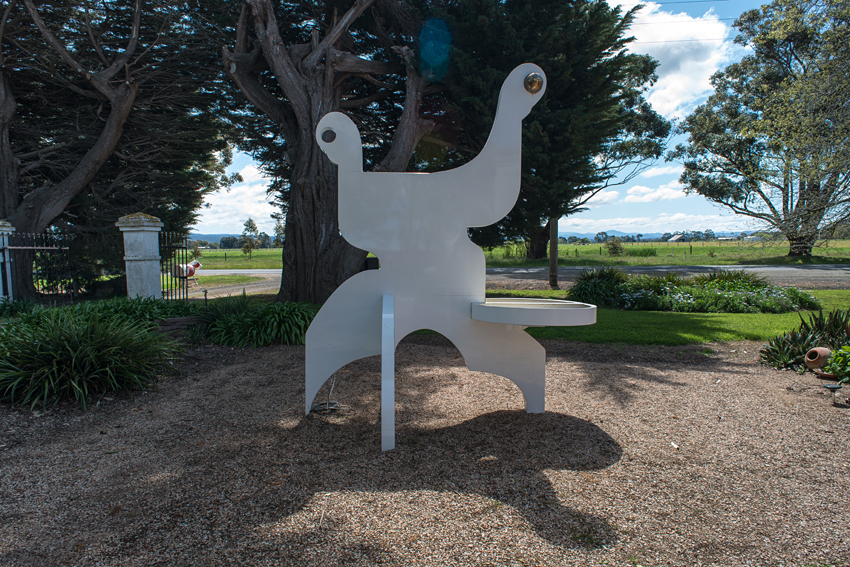
I was particularly worried about how this work, The Alfred Felton Memorial Sculpture, would fare in a new style place - I shouldn't have. When I was commissioned by the Felton Bequest to create this work there were 2 rather daunting conditions, he would be on constant display and could be displayed anywhere inside or outside the NGV International or Australia. For those that don't know Alfred Felton's massive bequest is the reason that the NGV has Australia's most significant art collection.


Here he is glimpsed from one of the "White Cube" style spaces looking very happy that he's surrounded by other people in Heads Up: Sculptural Portraiture and Representations of the Human Face. I love the fact that real sunlight finds it's way into this delightful architectural oasis.


and again from inside the more formal "gallery" space. Followed by some views of the show.


Me and Mr Felton in architecture

Given that it costs a small fortune to move this work, I'm guessing he'll be here for quite sometime, maybe they'll put some of the sculptural works that his bequest has funded in there with him next time, or little cameo shows of ceramics or sculpture, or even single short and sharp single artist surveys - who knows, but I did enjoy this outing for Mr Felton.


Feb 16, 2016

HARD EDGE Abstract Sculpture 1960s-70s....deja vu NGV


HARD EDGE Abstract Sculpture 
1960s-70s....deja vu @ NGV

C. Elwyn Dennis  Evidence of origin 1971 wood, lacquer


As my title suggests this exhibition has hurtled me back to the time when I was in my 20s and I'm reminded of the great artistic arguments and conceptual battles of my youth - my generation would have questioned the abstractness of Elwyn Dennis, Inga King and Lenton Parr. To me they were always abstracted rather than abstract, the Dennis above is quite organic and seems to defer to the biomorphism of Arp, Brancusi, Calder and Moore. To me this delightful sculpture is a personage, possibly a kind warrior carrying a huge drum stick rather than a spear.

Inge King Winged image 1964 welded steel

This is an abstracted angel or bird, standing on a traditional plinth - it is what happens when sculptors discover a liberating material and process, steel and welding on this occasion - they make the old ideas in the new material. Why was steel so liberating? put simply, it meant that a sculptor could make a permanent large object more quickly and cheaply than ever before. My generation couldn't understand why these steel sculptors had what professional welders would disparagingly call "cocky shit" welds and lousy examples of oxy-acetylene cutting. Cocky shit being a reference to the incompetence of farmer's welding skills.

Lenton Parr  Daedalus 1965 steel, enamel paint
To me this is a more abstracted person than the Inga King work, a kind of skeletal Henry Moore made of steel, interestingly both Lenton Parr and Ron Robertson-Swann spent time as Henry Moore's assistants. And while we're on interesting groupings in the exhibition, Robertson-Swann, David Wilson and I were the 3 sculptors invited by Denton Corker and Marshall to submit ideas for the Melbourne City Square sculpture, won by Ron with Vault. Wilson, Parr and I all lived within a short distance of each other in Hampton/Sandringham and were rudely called by Patrick McCaughey members of the Bayside Mafia. Robertson-Swann and Coleing disagreed so much about what contemporary steel sculpture should be that they once came to blows. 

What we really see in this exhibition is an evolution from abstracted to abstract.

Ron Robertson-Swann Maquette for Vault 1978 synthetic polymer paint on balsa wood

Clearly this doesn't appear to be representing any known thing, it is a group of related shapes that wander around engagingly in space. At the time we believed we were participating in a compositional revolution based on the idea that instead making a sculpture where the parts were subordinate to the whole (as with traditional thinking) our works were made up of parts that remained themselves, like words in a sentence, and were held together by the same kind of logic. 

David Wilson Untitled sculpture 12.71 1971 welded steel, lacquer

See what I mean? Wilson's work is just like a sentence, linear, logical and written on the ground - which in itself was a very exciting discovery for us. There was something very subversive about making flat sculpture, it was a kind of, Q: "when is a painting a sculpture?" A: "when it's lying flat on the floor", moment for us. 


Clive Murray-White Untitled yellow sculpture 1970 spun steel, paint

I've always claimed that this wasn't abstract at all, it is real things, doing real things in real space, one section is flat and just covers up a significant area of floor, the middle section appears capable of having grown up through the floor like a sort of bubble, so maybe there's a hole under it blowing stuff into it and the third section does the unthinkable, it flies. I'm very glad the NGV photographer got it dead right (thanks), perfectly arranged on the perfect white ground which allows viewers to see the other main concept in the work which only comes into view from this angle. From the way I see it, the middle section appears capable of hovering above the flat one, and the flying section hovers over the middle one - so in a sense, visually we have an impossible cone like form where slices fly above each other. 

I hope I'm not imagining this but, I do seem to remember one other thing that excited me a great deal 45 odd years ago, I think there's a little dent in the smallest flying section, it is as if the shape had taken off on its own and bumped into something pretty hard, a bit like an out of control drone.  

All photos courtesy of the NGV


Jan 3, 2016

Here's Why You Shouldn't Stop Saying 'I Could Do That' About Art


Just read this article - Here's Why You Should Stop Saying 'I Could Do That' About Art The Huffington Post Australia by Katherine Brooks 09/042015. Of course she's and everybody who agrees with her is wrong but as artists, for some very strange reason, we staunchly protect this untruth - it should read - Here's Why You Shouldn't Stop Saying 'I Could Do That' About Art. Just for the record I've been involved with this issue for an awfully long time - since 1967 to be exact, when the work shown above was conceived and exhibited, titled "Fragments of a larger system" it was not offered for sale but people were given permission to get their own version from their local plumbing suppliers. It is in fact a work that anyone can make but differs from most others because I've actually authorised you to do so. 

There's always a funny side to things like this - when the National Gallery of Victoria wanted it for their collection they approached me and I said, "Just go down to the nearest plumbing supplies and get your own." "No no," they replied "we must buy it from you". Me - "OK then, this is what I'll do - I'll go out and buy them and charge you exactly what they cost me"....... National Gallery Happy. 

There are countless works like this that anyone could make, just check out the Carl Andre catalogue on the net for a start. You could graduate to single colour paintings just buy ready made canvases and pots of ready mixed colours, browse the internet for anything that may be dead easy to get.

Ah but there's only one catch, never claim that it is YOUR art, it isn't, it is, instead, a forgery. But like with most things there is even a away around that little problem. There is a very long tradition in art of permitting and even encouraging people to copy other artist's work, it is seen as an important educative tool, but there is a convention that goes with it, you are obliged to declare that it is a copy by using the word "after" in your title, so if you make your own  Carl Andre Equivalent V111 brick work, you should call it Equivalent V111 after Carl Andre 1966-69.


Oct 21, 2015

Senior Company Artist - Loy Yang Power


Georgie Mattingley, our current artist in residence, came home from a day’s photographic shoot at Loy Yang power station to excitedly tell us that everyone still remembers my time out there as Senior Company Artist – Loy Yang Power, nearly 20 years ago. The memories came flooding back for me, I’ve always seen that period as one of the most influential in my life as an artist.


My 4 assistants Anton Vardy, Chris Roe, Drew Cole & Philip Toth 
paid for by Monash University - photo Angela Lynkushka
we used some of those cylinders (idlers) for the base of the big public sculpture

It is a grand title, but how it came to be is just as interesting as what we wound up doing with the big Power Co. It all started with Loy Yang Power approaching the head of the art school at Monash University Gippsland Campus in 1995 asking if they could develop a relationship. Put bluntly Monash didn’t really know what a relationship was and assumed that it meant Loy Yang giving the art school money for something like a scholarship and in return the school would badge exhibition catalogues with Loy Yang’s logo. Eventually after both Deputy and Head of school made no progress, the head, possibly in desperation, asked me to try to work out what all this relationship talk was really about.

I soon discovered that both Loy Yang’s CEO, Bob Patterson and head of Corporate Relations and Environment, Richard Elkington were extremely imaginative and creative people who had a vague hunch that artists and possibly their problem solving processes may in some way be harnessed for the company’s good. Over the occasional chat, the odd invitation to an event or informal lunch with Elkington I soon started to realise what all this relationship stuff actually meant, he would describe some of the company’s problems, I’d do the same from an artist’s perspective and we’d both contribute ideas for making things better for each other. Simple really.

Richard Elkington had an idea that I and some of my students could “style” their big Christmas corporate function and as we discussed it further I realised that he was asking us to create an event that expressed the company identity and lurking in this was a genuine belief in being as environmentally responsible as a coal fired power station could ever be, so without either being literal or ramming the message in the faces of their guests we designed the function. First little job a big success, and the students were nearly overwhelmed at being paid properly.


In our workshop - photo Angela Lynkushka

At roughly the same time we suggested that the company apply to the Australia Council for a “partnership” grant, we designed and wrote it around the general idea that the both company and artist would explore the notion that an artist could be very useful to a company and Loy Yang submitted it. The concept of Senior Company Artist – Loy Yang Power was born and coincidentally CEO Patterson during his dinner speech announced its success. He added that he’d been to another function full of major company CEOs a few days earlier, the conversation had got round to “corporate citizenship” and of course he was able to announce that they not only had a Senior Company Artist! but they’d also got a government grant to pay for it; a cause for significant adoration from his peers.

In a way we’d just proved how useful an artist could be, and this was before we’d really started.


Philip and Chris at work

The financial breakdown of the deal deserves a mention, my wages were paid for with the Australia Council grant, topped up to some extent by my main employer, Monash University, and Loy Yang supplied materials, tools, logistics, studio space, engineering, fabrication, documentation etc  which are, in effect, mostly in-kind costs using their own expertise and resources.


Finished major work prior to installation - photo The Visual Resource

The project was to run for 2 years (it actually continued for a further 2 years and during the first we would concentrate on the company’s own identity and its ability to communicate more effectively with all levels of government, whilst the second year was primarily devoted to the Latrobe Valley community.

We kicked–off by suggesting that Loy Yang Power place advertisements in the Saturday art pages of the Age and Australian newspapers thanking the Australia Council for their grant, it turned out, so the council told us, that this was first time that anybody had thanked them publicly, which was a big surprise to us.


The finished major work - Lars Compitalis 
in Victory Park Traralgon 
Loy Yang Power's gift to the La Trobe community
The Visual Resource

Underpinning the whole idea behind the Senior Company Artist model was the belief that pre-20th Century patronage may not have been quite as bad for the artists as we’d led ourselves to believe and that an up-dated version could be very useful in achieving things that many companies found very difficult.


The Federal Minister for the Arts the Hon Peter McGauran 
and Anton Vardy unveil - photo The Visual Resource

The sorts of questions senior management asked me to look at, were, most often, about improving its communication and access to all levels of government, it turned out that a reasonably well known artist could procure a cabinet minister far more easily than a big power company. For one smallish project we got personal signed letters of thanks from both the State Premier and Prime Minister.

The most interesting request came from the CEO who felt that the morale in a certain section could be improved, so he suggested that we move my studio nearer to them, just to see what might happen, again a huge success.

My art was never compromised in any way during the project, in fact I learned that the company had realised that the better I did as an artist the better it would be for them.

The nicest compliment we got was “He’s a lot more useful than a tennis player and a damn sight cheaper” (from a middle level company engineer)


CEO, Mayor, Minister and me (our kids in the background)

Sep 28, 2015

Cowwarr Art Space - from wreck to paradise


Yesterday I took some "spring" pictures of our building 
for the Cowwarr Art Space Newsletter


the grand old dame has come a long way since this


a winter view


a panorama of the gallery interior


the view to the north


the view to the north in winter


the view to the east from just outside my study


the view to the south - from the same place - I love that sculpture


the garden in spring


Sanné Mestrom's Weeping Woman in the garden


Sara Delany - a head of her time, looks towards the weeping woman,
for more about the Cowwarr Art Space click on the link in the links bar.


Sep 5, 2015

A new Australian Flag - September 1995 revisited


click for full size

click for full size - nice words from Betty Churcher, Director of the National Gallery of Australia

Chance had it that I wondered what I was doing 20 years ago, September 1995. No I wasn't designing new Australian flags as the items above may suggest, it was a fortuitous accident. Let me explain - one day back then Rodney Scherer, the director of the Latrobe Regional Gallery, showed me the abandoned theatre in the Old Morwell Town Hall (now the main gallery in the LRG) he was enthusiastic about someone using it for a sculpture installation and that sparked my own imagination and the general concept of the Temple of the Southern Cross  popped into being.

It developed very quickly and was based on the the idea that if Australia had been a different kind of culture we may have imagined that our Gods lived in the stars of the Southern Cross, and, each star contained deities responsible for different aspects of life. The space could be made to look as if devotees of this religious practice had, for some reason or other, abandoned everything in quite a hurry.

But, and there's always a but or two, Rodney Scherer, practical as ever, suddenly realised that we had a small but major problem. How would anyone find the entrance to this place or know that something was going in inside? He suggested that we put something outside on the street, it could have been any old sign but somehow I didn't like that and ferreted about in my mind for something a little more authentic. The idea of a relocatable flag pole and an instantly recognisable flag based on our fantastic night sky was born, of course it had to be called "Night Sky".


There are no good pictures of the flag flying in Morwell but here it is outside the Boisedale Public Hall which makes a nice segue into another historic moment related to the Temple and Night Sky. My memory may not be completely accurate here but I seem to remember Rod Scherer and I were showing the director of the Gippsland Gallery, Michael Young, the abandoned theatre, when he explained that his "new" public gallery was opening in September 1995 and he was on the hunt for suitable art events to use in his opening program. The conversation got around to the idea that nearly every little town has a public hall which could be used for a contemporary installation. Young's favourite was this one and the Temple of the Southern Cross became one of the special events associated with opening of his new gallery. In effect the two regional gallery directors had devised a touring show for me using public halls and abandoned spaces.


Interior of the Boisedale Public Hall hosting the Temple of the Southern Cross

This was opened by the outstanding artist and enthusiastic raconteur, John Wolseley, on 16 September 1995. His highly animated speech contained some very interesting observations concerning the expanded notions of space that he saw in this work. They have influenced me ever since. 


click for full size, image of The Temple of the Southern Cross in the Old Morwell Town Hall

This touring exhibition/installation went on to four more venues, The Nicholson Street Gallery in Bairnsdale, The Cowwarr Art Space and then in September 1997 to the RMIT Gallery and Charles Nodrum Gallery, both in Melbourne.


Night Sky - flying outside the RMIT Gallery, Swanston Street Melbourne


Interior view of the "Temple" RMIT 1997


Aug 21, 2015

Wine Women & Wingadal


What an interesting week: first I receive a copy of this very handsome book, Wingadal The John Symond Collection, written by Elizabeth Hastings, here's my 2002 marble and aluminium work, Art over Modern Art - more over less with a double page spread to itself. It's also fascinating being reminded of comments people have written about you quite some years ago; the text includes this from John McDonald ".... When Murray-White places a large stylised stone head upon a modular aluminium plinth he is telescoping the entire history of sculpture into one simple juxtaposition. In a glance we travel from Mesopotamia to Minimalism." Ah yes - that art over modern Art preoccupation/theme is still there!


Changing the topic completely: This week I also helped my friends out from Narkoojee winery, Val and Harry Friend, by taking a few pictures of their latest stunning offerings, above the medal winning selection, below a collage of the complete set.I can feel a thirst coming on..... right now!


"Aphrodite" shown in the top photo, from last year's Walking Women - Standing Monash exhibition now comes with 2 plinths, one bronze and granite and the other my Alberto Giacometti inspired scaffolding walking person just like the one below. Art over Modern Art alive and well.


Soon all the walking women will have mix and match, two for the price of one, swapable, transformer stands.